Increasingly, collaboration is the route in. Brand x artist. Brand x festival. Brand x sport. Brand x brand. But just because two logos look good next to each other doesn’t mean the collaboration makes sense.
The question in the room shouldn’t be, “What could these two brands make together?” It should be, “How do we create an experience people will actually want to take part in?” That distinction matters because a good activation or partnership should be audience-focused before it is brand-focused. It needs to give people access to something they already care about, want to experience or want to be part of. The brand’s job is then to understand how it fits into and helps curate that story. Not how it owns it or dominates it, but how it contributes to it.
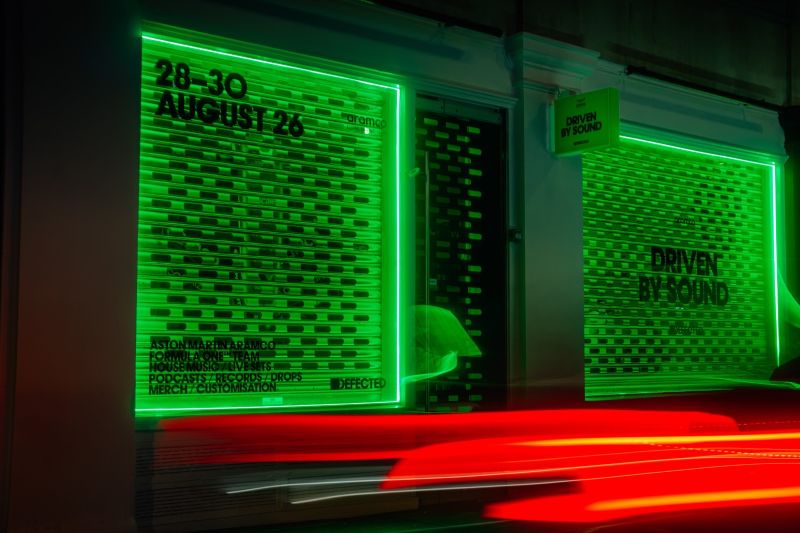
That’s what interested me about Driven By Sound, the recent collaboration between Aston Martin Aramco Formula One Team and Defected Records in Soho, London. From 27–30 August 2026, the two brands took over 19 D’Arblay Street with a programme built around house music and F1, including live DJ sets, vinyl, limited-edition merchandise, a run club, talks and community programming. Defected also described programming for FLINTA communities, while coverage of the Friday programme detailed a panel and mixing masterclass for women and non-binary artists.
On paper, F1 x house music could very easily have become a logo-swap exercise. Put two recognisable brands together, make some merch, throw a party, create the content and move on. Instead, the activation gave people a reason to participate. Aston Martin described Driven By Sound as part of its wider I / AM DROPS fan programme, while Defected framed the collaboration around bringing its music community together with F1 fans.
What I find interesting is the choice of scale and setting. This was in Soho rather than a huge festival-style environment, in a part of London with a genuine connection to record shops, nightlife and music culture. Defected’s Simon Dawson noted that D’Arblay Street was the location of the label’s first office and sits within an area historically associated with record shops including Black Market Records, Reckless, Vinyl Junkies and Phonica.
I’m not suggesting that proves the activation was commercially more successful, or that a smaller footprint automatically produces stronger brand results. Without attendance, brand-lift, acquisition or conversion data, that would be an assumption. What I do think is that the choices behind the activation created the conditions for relevance. The location, programme and format appeared to have been considered around the people they wanted to attract rather than simply around achieving the biggest possible footprint.
Marketing is understandably obsessed with numbers. Reach, impressions, views, footfall and engagement matter because ultimately marketing needs to create commercial value. But sometimes I think we allow the size of the number to become the idea itself.
If an experience genuinely changes how ten people think or feel about your brand, that can be valuable. If you can do it for 100,000 people, even better. But those smaller experiences still have to justify themselves. Intimacy isn’t an excuse for avoiding measurement. The question becomes what you were trying to achieve and whether the activation moved that audience in a commercially meaningful direction.
For one brand, that might mean new customer acquisition. For another it might be preference, consideration, membership sign-ups, product trial, data capture, repeat purchase or a measurable change in brand perception. A 200-person experience that reaches exactly the right people and meaningfully shifts behaviour can be more valuable than an activation seen passively by hundreds of thousands. Equally, an intimate experience that everybody loves but contributes nothing to the business is difficult to defend simply because it felt culturally credible.
Scale, then, is not the enemy. It’s just secondary to knowing what you’re trying to achieve. Every brand understands its own budget, audience and commercial reality. We can all dream about the huge activation that takes over a city, goes viral and wins awards, but those things aren’t the only definition of effective marketing. A series of smaller and more relevant activities can be powerful too, provided there is a clear idea of what success means and a way of measuring whether they achieved it.
This is also why I think the most important thinking happens before a traditional creative agency is briefed. The creative execution matters enormously, but it should be answering a strategy rather than trying to invent one retrospectively.
The order matters. If you start with the final question, you’re immediately talking about formats: a pop-up, a collaboration, a party, a film, some merch. If you begin with the audience, you force yourself to understand the person before deciding what the brand wants to make.
“Why do they care?” is about understanding the existing behaviour, passion or need. “What strengthens the connection?” asks what could genuinely improve their relationship with that thing. Only then should you ask what role the brand can credibly play. Once those four questions are clear, the creative question becomes much more useful because you are no longer making something simply for the sake of having an activation.
Brand collaboration has become big business, and understandably so. Partnerships can introduce brands to new audiences, borrow complementary expertise and create something neither organisation could produce alone. But if the process begins with, “These two brands would look great together,” you’re potentially solving the wrong problem. You’re starting with the brands and then working backwards to find an audience justification.
I’d rather see the process run in the opposite direction: understand the audience, understand their motivation, identify what would improve the experience, define the role your brand has within that, and then decide what deserves to exist.
People have different words for what happens when a brand gets this right. Authenticity. Cultural fit. Relevance. Credibility. I tend to think about it as permission.
What has your audience given your brand permission to do?
Brands don’t get to decide for themselves where they belong. Audiences make that judgement through their response. They decide whether your presence feels natural or intrusive, whether you’re improving something they care about or simply attaching yourself to it, and whether you have earned a role in that space.
Permission doesn’t mean a brand can only ever operate within its existing category. That would make culture incredibly boring. Part of the opportunity of collaboration is creating unexpected connections. But there needs to be a reason those connections matter to the audience, not simply a reason they look useful to the brands involved.
And if you haven’t yet earned permission, that doesn’t mean you can never enter that world. It may simply mean the first job is to build the relationship. Listen more. Understand more. Contribute something useful. Give people a reason to want you there.
That’s the idea I keep coming back to when I look at Driven By Sound. I’m not claiming the activation has proven a particular return without the data to support that. What interested me was the thinking visible in the execution: a specific place, a participatory programme and an attempt to create something around two communities rather than simply put two brands next to each other.
As more brands chase collaborations, partnerships and cultural moments, I think that distinction becomes increasingly important.
Increasingly, collaboration is the route in. Brand x artist. Brand x festival. Brand x sport. Brand x brand. But just because two logos look good next to each other doesn’t mean the collaboration makes sense.
The question in the room shouldn’t be, “What could these two brands make together?” It should be, “How do we create an experience people will actually want to take part in?” That distinction matters because a good activation or partnership should be audience-focused before it is brand-focused. It needs to give people access to something they already care about, want to experience or want to be part of. The brand’s job is then to understand how it fits into and helps curate that story. Not how it owns it or dominates it, but how it contributes to it.
That’s what interested me about Driven By Sound, the recent collaboration between Aston Martin Aramco Formula One Team and Defected Records in Soho, London. From 27–30 August 2026, the two brands took over 19 D’Arblay Street with a programme built around house music and F1, including live DJ sets, vinyl, limited-edition merchandise, a run club, talks and community programming. Defected also described programming for FLINTA communities, while coverage of the Friday programme detailed a panel and mixing masterclass for women and non-binary artists.
On paper, F1 x house music could very easily have become a logo-swap exercise. Put two recognisable brands together, make some merch, throw a party, create the content and move on. Instead, the activation gave people a reason to participate. Aston Martin described Driven By Sound as part of its wider I / AM DROPS fan programme, while Defected framed the collaboration around bringing its music community together with F1 fans.
What I find interesting is the choice of scale and setting. This was in Soho rather than a huge festival-style environment, in a part of London with a genuine connection to record shops, nightlife and music culture. Defected’s Simon Dawson noted that D’Arblay Street was the location of the label’s first office and sits within an area historically associated with record shops including Black Market Records, Reckless, Vinyl Junkies and Phonica.
I’m not suggesting that proves the activation was commercially more successful, or that a smaller footprint automatically produces stronger brand results. Without attendance, brand-lift, acquisition or conversion data, that would be an assumption. What I do think is that the choices behind the activation created the conditions for relevance. The location, programme and format appeared to have been considered around the people they wanted to attract rather than simply around achieving the biggest possible footprint.
Marketing is understandably obsessed with numbers. Reach, impressions, views, footfall and engagement matter because ultimately marketing needs to create commercial value. But sometimes I think we allow the size of the number to become the idea itself.
If an experience genuinely changes how ten people think or feel about your brand, that can be valuable. If you can do it for 100,000 people, even better. But those smaller experiences still have to justify themselves. Intimacy isn’t an excuse for avoiding measurement. The question becomes what you were trying to achieve and whether the activation moved that audience in a commercially meaningful direction.
For one brand, that might mean new customer acquisition. For another it might be preference, consideration, membership sign-ups, product trial, data capture, repeat purchase or a measurable change in brand perception. A 200-person experience that reaches exactly the right people and meaningfully shifts behaviour can be more valuable than an activation seen passively by hundreds of thousands. Equally, an intimate experience that everybody loves but contributes nothing to the business is difficult to defend simply because it felt culturally credible.
Scale, then, is not the enemy. It’s just secondary to knowing what you’re trying to achieve. Every brand understands its own budget, audience and commercial reality. We can all dream about the huge activation that takes over a city, goes viral and wins awards, but those things aren’t the only definition of effective marketing. A series of smaller and more relevant activities can be powerful too, provided there is a clear idea of what success means and a way of measuring whether they achieved it.
This is also why I think the most important thinking happens before a traditional creative agency is briefed. The creative execution matters enormously, but it should be answering a strategy rather than trying to invent one retrospectively.
The order matters. If you start with the final question, you’re immediately talking about formats: a pop-up, a collaboration, a party, a film, some merch. If you begin with the audience, you force yourself to understand the person before deciding what the brand wants to make.
“Why do they care?” is about understanding the existing behaviour, passion or need. “What strengthens the connection?” asks what could genuinely improve their relationship with that thing. Only then should you ask what role the brand can credibly play. Once those four questions are clear, the creative question becomes much more useful because you are no longer making something simply for the sake of having an activation.
Brand collaboration has become big business, and understandably so. Partnerships can introduce brands to new audiences, borrow complementary expertise and create something neither organisation could produce alone. But if the process begins with, “These two brands would look great together,” you’re potentially solving the wrong problem. You’re starting with the brands and then working backwards to find an audience justification.
I’d rather see the process run in the opposite direction: understand the audience, understand their motivation, identify what would improve the experience, define the role your brand has within that, and then decide what deserves to exist.
People have different words for what happens when a brand gets this right. Authenticity. Cultural fit. Relevance. Credibility. I tend to think about it as permission.
What has your audience given your brand permission to do?
Brands don’t get to decide for themselves where they belong. Audiences make that judgement through their response. They decide whether your presence feels natural or intrusive, whether you’re improving something they care about or simply attaching yourself to it, and whether you have earned a role in that space.
Permission doesn’t mean a brand can only ever operate within its existing category. That would make culture incredibly boring. Part of the opportunity of collaboration is creating unexpected connections. But there needs to be a reason those connections matter to the audience, not simply a reason they look useful to the brands involved.
And if you haven’t yet earned permission, that doesn’t mean you can never enter that world. It may simply mean the first job is to build the relationship. Listen more. Understand more. Contribute something useful. Give people a reason to want you there.
That’s the idea I keep coming back to when I look at Driven By Sound. I’m not claiming the activation has proven a particular return without the data to support that. What interested me was the thinking visible in the execution: a specific place, a participatory programme and an attempt to create something around two communities rather than simply put two brands next to each other.
As more brands chase collaborations, partnerships and cultural moments, I think that distinction becomes increasingly important.


