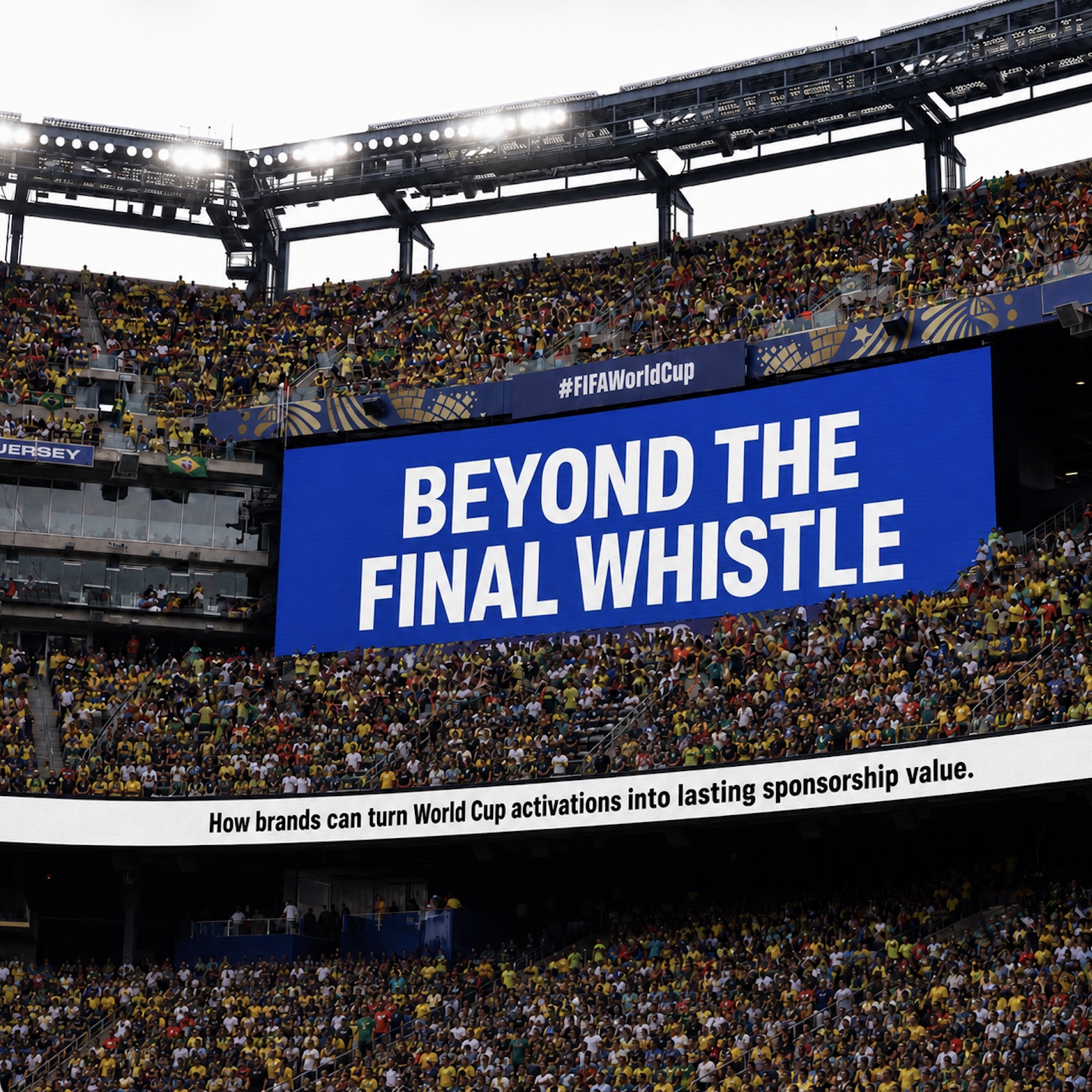
The trophy has been lifted, the fan zones have been dismantled and millions of pounds’ worth of World Cup advertising has disappeared. For many brands, that is the end of the campaign. It shouldn’t be.
Brands spend months negotiating rights, producing content and planning activations around the biggest sporting event on the planet. For a few weeks, the investment delivers huge audiences, packed experiences and impressive engagement figures. Then the branding comes down, the media spend stops and attention moves elsewhere.
The strongest sports sponsorship activations use the tournament to create something with a longer lifespan, whether that is an audience, a recognisable platform, a useful service or a stronger place within football culture.
A simple way to judge any sponsorship activation is to ask four questions: who can the brand still reach, what idea can it still use, what behaviour can it continue encouraging and what has it created that people still value? If the answer to all four disappears with the final whistle, the activation has probably left value behind.
Looking back at some of the best World Cup brand activations, six lessons stand out.
Every major tournament ends with sponsors celebrating record-breaking reach, millions of views and impressive engagement figures. Those metrics matter, but attention has a short shelf life. Unless supporters have a reason to continue engaging, much of the value disappears as quickly as it arrived.
Bank of America’s Fan Bands showed how an activation can create something more lasting. Supporters collected and traded beads linked to teams, cities and tournament stages, turning a branded giveaway into a social behaviour.
The idea could continue through future tournaments or the bank’s wider sports partnerships, giving it a recognisable asset to return to. Too many brands invest heavily in attracting an audience they never speak to again. The strongest activations create a natural next step.
Why it works
Supporters became active participants rather than passive recipients of branded merchandise.
The lesson
The World Cup should begin the relationship, not end it.
Some World Cup campaigns are highly visible during the competition and then disappear. A stronger approach is to place the tournament within a wider platform that already has a reason to exist.
Lay’s RePlay is a strong example. Launched before the tournament, the initiative turns recycled crisp packets into community pitches and supports local football programmes. The World Cup did not create the idea; it gave an established platform a much larger stage.
When brands invent a new platform for every partnership, each campaign has to establish a fresh message and new associations. Very little value carries from one sponsorship to the next.
A consistent platform allows every activation to reinforce the same story. The tournament creates the spike in attention, but the brand already knows what it wants to do with it.
Why it works
The sponsorship feels like part of a genuine commitment rather than a temporary attempt to borrow relevance.
The lesson
The World Cup should accelerate the brand’s platform, not become the platform.
Some of the strongest activations succeeded because they made familiar supporter behaviours feel bigger and more rewarding.
Panini expanded the established ritual of collecting and swapping stickers through large-scale exchange events and a digital collection app. McDonald’s took an equally straightforward approach by creating collectible World Cup cups featuring famous players.
Neither idea needed complicated technology or a lengthy explanation. They worked because people already understood the behaviour and wanted to participate.
The opportunity also extends beyond the final whistle. Collections can continue around clubs, international fixtures, women’s football and future tournaments. Digital communities can remain active, while new editions give supporters a reason to return.
Why it works
The brands added value to behaviours that already belonged to football supporters.
The lesson
Do not just create something people remember. Create something they want to continue.
Brands produce an enormous amount of content around the World Cup, much of which is created for a short period and then quietly archived.
LEGO showed how one clear idea could extend across different formats. Its giant World Cup Trophy at Rockefeller Plaza generated attention, while the wider activation included experiences, content and products that encouraged people to build and participate.
MatchWornShirt’s Legend Collection in New York also had potential beyond its original pop-up. By presenting match-worn shirts as pieces of football history, it created an idea that could continue as a touring exhibition, editorial series or cultural platform.
The same principle applies to interviews, photography and ambassador relationships. To give those assets a longer life, usage rights and talent agreements need to be considered before production begins.
Why it works
One strong idea becomes more valuable when it can work across content, experiences, retail and future campaigns.
The lesson
Do not give every asset the same expiry date as the media plan.
Legacy does not have to mean building a stadium or permanent fan zone. The more useful question is whether the sponsorship leaves supporters, customers or communities with something they can continue using.
Airbnb used the tournament to grow its network of hosts while supporting projects in host cities. The immediate opportunity was increased demand for accommodation, but the longer-term value included new hosts, new customers and stronger local relationships.
The adidas Foundation’s Play Coll3ctive programme took a community-led approach, supporting organisations already working with young people across World Cup regions. Rather than creating a short-lived branded initiative, it strengthened groups capable of continuing the work afterwards.
Both approaches feel connected to the businesses behind them, rather than like generic legacy initiatives that could belong to any sponsor.
Why it works
The brand remains relevant because the value it created continues after the tournament branding disappears.
The lesson
Do not only leave people with a memory of the campaign. Leave them with something worth keeping.
The biggest mistake brands make with sponsorship legacy often happens before the competition begins.
Too many organisations wait until the partnership has been signed before deciding what should happen afterwards. By then, the rights package has been agreed, content permissions are fixed, ambassador contracts have end dates and most of the budget has been allocated.
Legacy needs to influence those decisions from the start. Brands should decide what they want to own once the tournament is over, whether that is a stronger association with football, a new customer audience, an ongoing content property or a platform that can grow through future partnerships.
That answer should shape both the rights being negotiated and the way success is measured. The contract should be considered not only for what it permits during the tournament, but for what it enables afterwards.
Can the brand continue using the content? Does it have permission to communicate with the audience it acquires? Do talent agreements extend into the domestic season? Has budget been protected for the months after the final?
A brand cannot nurture an audience it has no permission to contact, continue a content platform after its usage rights expire or sustain a community programme if every pound has been spent launching it.
Why it works
Starting with the long-term objective helps brands prioritise rights that create lasting value rather than those that simply look exciting.
The lesson
Do not only ask what the brand will do at the World Cup. Ask what the World Cup will allow the brand to do next.
Legacy should not be treated as a separate part of the sponsorship plan. It should describe the value the brand retains once the competition has finished.
That value might be commercial, through customers and business relationships. It could be cultural, through a behaviour or idea that becomes part of how supporters experience football, or community-focused through programmes that continue operating.
A sports sponsorship activation agency should not only help a brand become visible during a competition. It should help determine what the brand wants to retain afterwards, then shape the rights, creative platform, content strategy and measurement plan around that objective.
That might involve identifying which rights will support ongoing activity, developing an idea that can continue without tournament branding, creating a useful audience journey or securing content and talent agreements with a longer lifespan.
The strongest World Cup sponsors will not necessarily be those that spent the most or appeared most frequently. They will be the brands that used an exceptional period of attention to build something more valuable than attention itself.
Rights give brands permission to enter the conversation. A lasting idea gives people a reason to keep listening once the football has moved on.
LoveGunn is a full-service creative agency helping brands activate sponsorships and partnerships across their entire lifecycle.
We act as an extension of your team throughout the season, from setting objectives, KPIs and measures of ROI through to strategy, planning, club liaison, campaign creation, creative activation, content production, delivery and performance reporting.
Whether you are considering a new partnership or looking to make an existing one work harder, get in touch with Chris at chris@lovegunn.co
Turning up is easy. Creating something that lasts is the useful bit.
The trophy has been lifted, the fan zones have been dismantled and millions of pounds’ worth of World Cup advertising has disappeared. For many brands, that is the end of the campaign. It shouldn’t be.
Brands spend months negotiating rights, producing content and planning activations around the biggest sporting event on the planet. For a few weeks, the investment delivers huge audiences, packed experiences and impressive engagement figures. Then the branding comes down, the media spend stops and attention moves elsewhere.
The strongest sports sponsorship activations use the tournament to create something with a longer lifespan, whether that is an audience, a recognisable platform, a useful service or a stronger place within football culture.
A simple way to judge any sponsorship activation is to ask four questions: who can the brand still reach, what idea can it still use, what behaviour can it continue encouraging and what has it created that people still value? If the answer to all four disappears with the final whistle, the activation has probably left value behind.
Looking back at some of the best World Cup brand activations, six lessons stand out.
Every major tournament ends with sponsors celebrating record-breaking reach, millions of views and impressive engagement figures. Those metrics matter, but attention has a short shelf life. Unless supporters have a reason to continue engaging, much of the value disappears as quickly as it arrived.
Bank of America’s Fan Bands showed how an activation can create something more lasting. Supporters collected and traded beads linked to teams, cities and tournament stages, turning a branded giveaway into a social behaviour.
The idea could continue through future tournaments or the bank’s wider sports partnerships, giving it a recognisable asset to return to. Too many brands invest heavily in attracting an audience they never speak to again. The strongest activations create a natural next step.
Why it works
Supporters became active participants rather than passive recipients of branded merchandise.
The lesson
The World Cup should begin the relationship, not end it.
Some World Cup campaigns are highly visible during the competition and then disappear. A stronger approach is to place the tournament within a wider platform that already has a reason to exist.
Lay’s RePlay is a strong example. Launched before the tournament, the initiative turns recycled crisp packets into community pitches and supports local football programmes. The World Cup did not create the idea; it gave an established platform a much larger stage.
When brands invent a new platform for every partnership, each campaign has to establish a fresh message and new associations. Very little value carries from one sponsorship to the next.
A consistent platform allows every activation to reinforce the same story. The tournament creates the spike in attention, but the brand already knows what it wants to do with it.
Why it works
The sponsorship feels like part of a genuine commitment rather than a temporary attempt to borrow relevance.
The lesson
The World Cup should accelerate the brand’s platform, not become the platform.
Some of the strongest activations succeeded because they made familiar supporter behaviours feel bigger and more rewarding.
Panini expanded the established ritual of collecting and swapping stickers through large-scale exchange events and a digital collection app. McDonald’s took an equally straightforward approach by creating collectible World Cup cups featuring famous players.
Neither idea needed complicated technology or a lengthy explanation. They worked because people already understood the behaviour and wanted to participate.
The opportunity also extends beyond the final whistle. Collections can continue around clubs, international fixtures, women’s football and future tournaments. Digital communities can remain active, while new editions give supporters a reason to return.
Why it works
The brands added value to behaviours that already belonged to football supporters.
The lesson
Do not just create something people remember. Create something they want to continue.
Brands produce an enormous amount of content around the World Cup, much of which is created for a short period and then quietly archived.
LEGO showed how one clear idea could extend across different formats. Its giant World Cup Trophy at Rockefeller Plaza generated attention, while the wider activation included experiences, content and products that encouraged people to build and participate.
MatchWornShirt’s Legend Collection in New York also had potential beyond its original pop-up. By presenting match-worn shirts as pieces of football history, it created an idea that could continue as a touring exhibition, editorial series or cultural platform.
The same principle applies to interviews, photography and ambassador relationships. To give those assets a longer life, usage rights and talent agreements need to be considered before production begins.
Why it works
One strong idea becomes more valuable when it can work across content, experiences, retail and future campaigns.
The lesson
Do not give every asset the same expiry date as the media plan.
Legacy does not have to mean building a stadium or permanent fan zone. The more useful question is whether the sponsorship leaves supporters, customers or communities with something they can continue using.
Airbnb used the tournament to grow its network of hosts while supporting projects in host cities. The immediate opportunity was increased demand for accommodation, but the longer-term value included new hosts, new customers and stronger local relationships.
The adidas Foundation’s Play Coll3ctive programme took a community-led approach, supporting organisations already working with young people across World Cup regions. Rather than creating a short-lived branded initiative, it strengthened groups capable of continuing the work afterwards.
Both approaches feel connected to the businesses behind them, rather than like generic legacy initiatives that could belong to any sponsor.
Why it works
The brand remains relevant because the value it created continues after the tournament branding disappears.
The lesson
Do not only leave people with a memory of the campaign. Leave them with something worth keeping.
The biggest mistake brands make with sponsorship legacy often happens before the competition begins.
Too many organisations wait until the partnership has been signed before deciding what should happen afterwards. By then, the rights package has been agreed, content permissions are fixed, ambassador contracts have end dates and most of the budget has been allocated.
Legacy needs to influence those decisions from the start. Brands should decide what they want to own once the tournament is over, whether that is a stronger association with football, a new customer audience, an ongoing content property or a platform that can grow through future partnerships.
That answer should shape both the rights being negotiated and the way success is measured. The contract should be considered not only for what it permits during the tournament, but for what it enables afterwards.
Can the brand continue using the content? Does it have permission to communicate with the audience it acquires? Do talent agreements extend into the domestic season? Has budget been protected for the months after the final?
A brand cannot nurture an audience it has no permission to contact, continue a content platform after its usage rights expire or sustain a community programme if every pound has been spent launching it.
Why it works
Starting with the long-term objective helps brands prioritise rights that create lasting value rather than those that simply look exciting.
The lesson
Do not only ask what the brand will do at the World Cup. Ask what the World Cup will allow the brand to do next.
Legacy should not be treated as a separate part of the sponsorship plan. It should describe the value the brand retains once the competition has finished.
That value might be commercial, through customers and business relationships. It could be cultural, through a behaviour or idea that becomes part of how supporters experience football, or community-focused through programmes that continue operating.
A sports sponsorship activation agency should not only help a brand become visible during a competition. It should help determine what the brand wants to retain afterwards, then shape the rights, creative platform, content strategy and measurement plan around that objective.
That might involve identifying which rights will support ongoing activity, developing an idea that can continue without tournament branding, creating a useful audience journey or securing content and talent agreements with a longer lifespan.
The strongest World Cup sponsors will not necessarily be those that spent the most or appeared most frequently. They will be the brands that used an exceptional period of attention to build something more valuable than attention itself.
Rights give brands permission to enter the conversation. A lasting idea gives people a reason to keep listening once the football has moved on.
LoveGunn is a full-service creative agency helping brands activate sponsorships and partnerships across their entire lifecycle.
We act as an extension of your team throughout the season, from setting objectives, KPIs and measures of ROI through to strategy, planning, club liaison, campaign creation, creative activation, content production, delivery and performance reporting.
Whether you are considering a new partnership or looking to make an existing one work harder, get in touch with Chris at chris@lovegunn.co
Turning up is easy. Creating something that lasts is the useful bit.


